

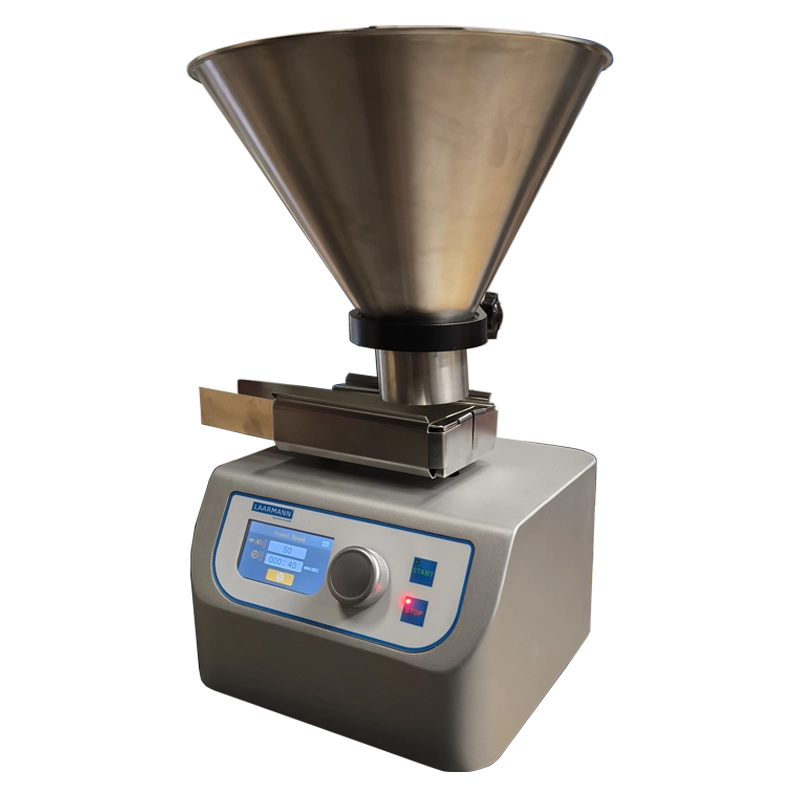
LMVF100 Vibratory Feeder
The LM-VF100 Vibratory Feeder is designed for the continuous feeding and transportation of free flowing and powdery materials
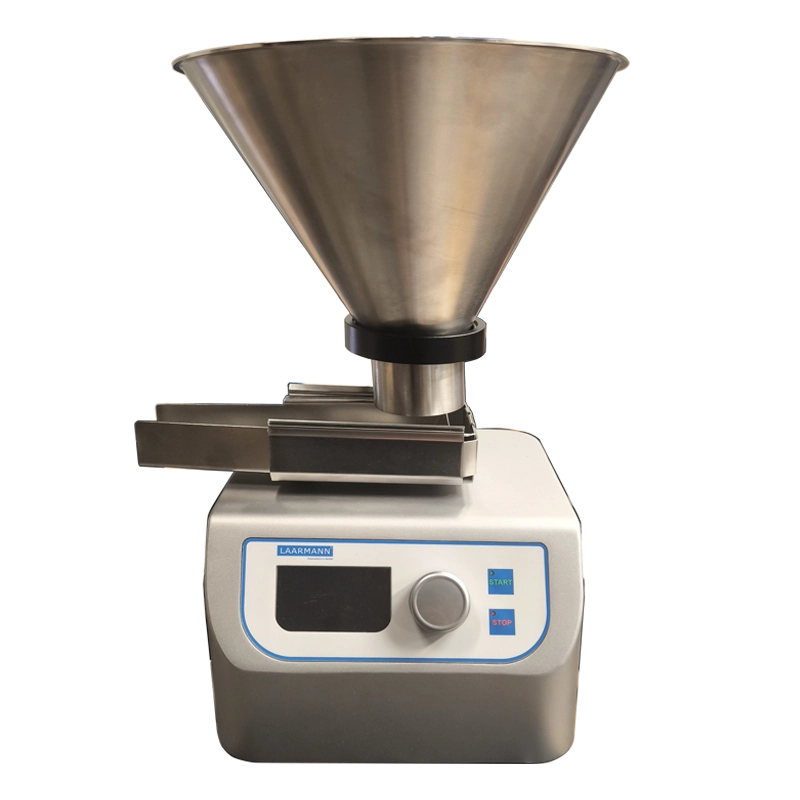
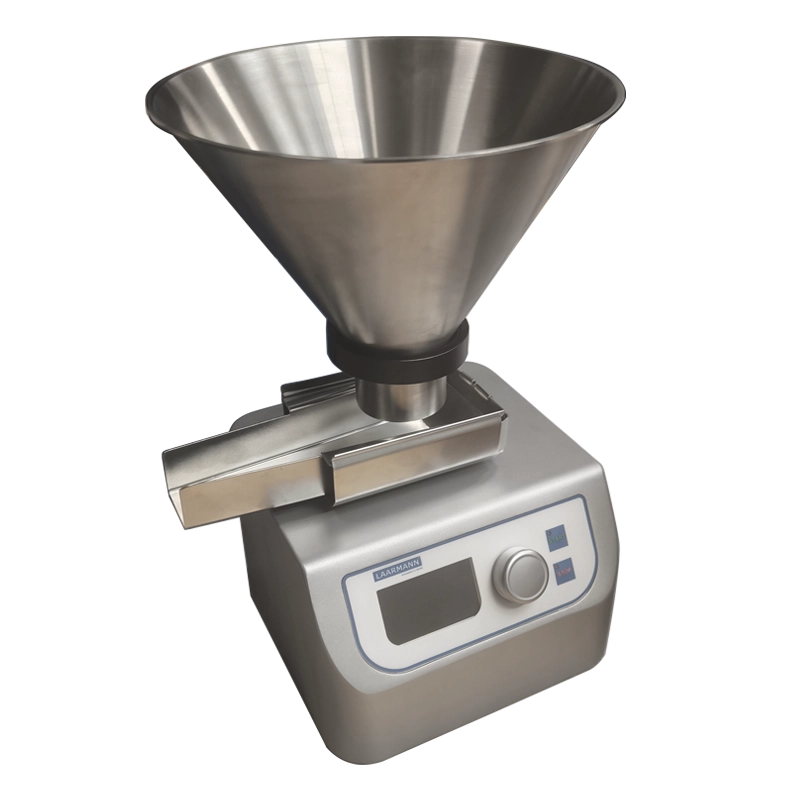
A laboratory vibratory feeder is a precise and efficient device used to feed or convey small quantities of bulk materials, such as powders, granules, or fine aggregates, in laboratory and testing environments. It operates using controlled vibrations to move material steadily along a tray, trough, or tube, ensuring a consistent and regulated flow. This makes it ideal for feeding sample materials into equipment like crushers, grinders, sieves, or analytical instruments for preparation or analysis.
Features and Benefits
- Easy to operate
- Time setting adjustment
- Speed setting adjustment
- Ideal of laboratory usage
- Compatible with other laboratory equipment such as the ultra centrifugal mill, rsd4 and disc mill

Technical Specifications
| Applications | feeding, conveying |
| Applications fields | Agriculture | Biology | Chemistry / Plastics | Construction Materials | Engineering / Electronics | Environment / Recycling | Geology / Metallurgy | Glass / Ceramics | Medicine / Pharmaceuticals | Mining and Mineral Processing | Cement and Building Materials Industry | Food and Feed Production | Pharmaceuticals | Environmental Labs (e.g. Soil and Waste Analysis) |
| Working principle | The LM/VF100 sample feeder system ensures consistent and controlled material delivery by integrating a bulk laboratory feeder with a precision vibratory feeder. As the material is pre-fed from the bulk hopper, it is transferred onto the vibratory channel, where adjustable amplitude and frequency create a uniform, continuous flow toward downstream equipment. This setup stabilizes the feeding process, prevents blockages, and enables precise dosing of powdered or granular materials. By maintaining a constant and reproducible feed rate, the system improves sample preparation efficiency and ensures reliable, repeatable results for subsequent processing or analysis. |
| Maximum feed size* | ≤ 10 mm |
| Batch size / feed quantity* | ≤ 5000 ml |
| Throughput | ≤ 0.5Lmin |
| Speed setting | 1 - 99 min |
| Hopper volume | ≤ 3.5l |
| Feeder width | 15 mm / 40 mm / 75 mm |
| Feeder length | 210 mm |
| Sample volume | Continuous up to 5l/min |
| Material transport method | Vibrating chute |
| Product-contact parts | Aluminum |
| Setting adjustment method | Digital control panel |
| Time setting | < 99min |
| Setting options | vibration frequency, timed |
| Fuses | 10amp glass fuse |
| Noise emission | ± 35 dB(A) |
| Electrical requirements | 110-120V or 220-240V, 50/60 Hz |
| Power supply | < 30Watt |
| Power connection | 1 phase |
| Standard | CE |
| Protection code | IP20 |
| Weight | < 10kg |
| Dimensions (width x length x height) | 260 x 280 x 420 (W x D x H in mm) |
Vibratory feeder working principle
Powered by an electromagnetic vibration system, the feeder oscillates at high frequencies between 50 and 60 Hz, which creates a gentle, controlled movement of the material.
The amplitude and frequency of the vibrations can be adjusted to accommodate different material types and flow rates.
Vibratory feeders in laboratory settings allow for precise control over the feed rate.
This precise control is essential in laboratory environments where accuracy in sample preparation is crucial.
The tray or trough is usually made from stainless steel or other non-reactive materials to handle various types of materials, including abrasive or corrosive substances.
Laboratory vibratory feeders are typically compact and lightweight, designed to fit easily into laboratory setups where space may be limited.
Despite their small footprint, they are built for durability and consistent performance over long periods.
The feeder ensures uniform material flow, preventing clumping or uneven feeding, which is essential for accurate testing and analysis in the lab.
This reduces the risk of blockages or material spills, contributing to a smooth sample preparation process.
Laboratory vibratory feeders often come with features to reduce noise and control dust, which is crucial in a lab environment to maintain a safe and quiet workspace.
Some models may include dust-tight enclosures or covers to minimize material loss and contamination.
Designed for simple operation, the feeders often come with intuitive controls and straightforward adjustment features for vibration intensity and flow rate.
They are also easy to clean and maintain, with removable trays and minimal moving parts, reducing downtime and ensuring long-lasting performance.

LMVF100 Vibratory Feeder FAQ (Frequently Asked Questions)
Applications
Vibratory feeders are used to precisely control the feed of small sample quantities into crushers, grinders, or sieves for further processing or testing. In laboratories focused on mineralogy, chemistry, or material science, they are essential for accurately feeding powders or small granular materials for analysis, such as in particle size analysis or composition testing. Consistent and controlled feeding is critical for ensuring that tests and analysis in the lab yield reliable, reproducible results, particularly in industries like mining, pharmaceuticals, chemicals, and food testing.