

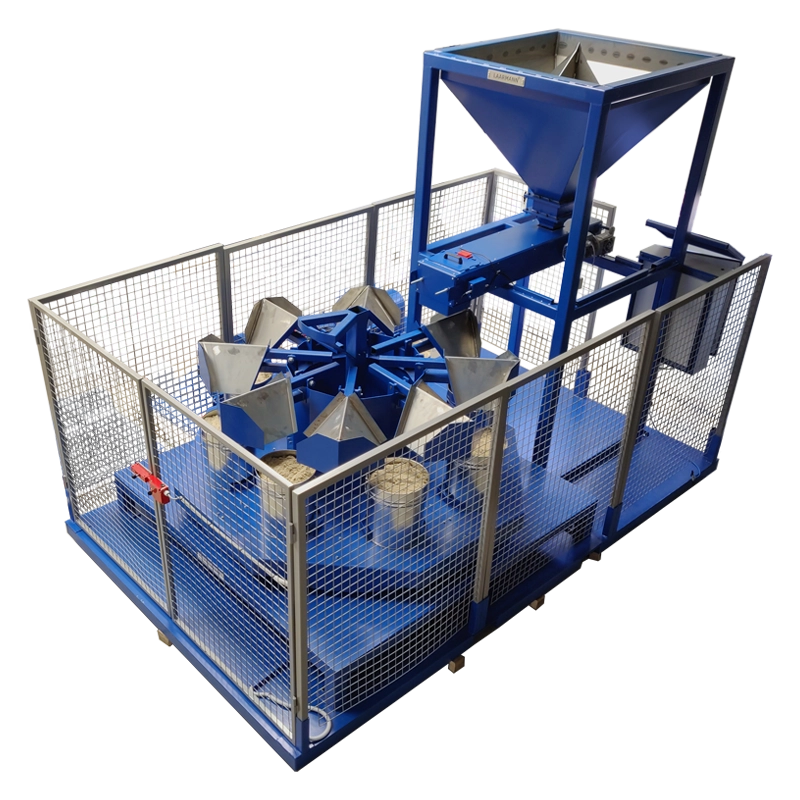
300L Rotary Sample Divider
The LAARMANN Sampling installation is a 300L system designed to divide a large sample into 8 representative sub-samples for later processing.

The system has a large funnel where the material is loaded using a Forklift. This material comes often directly from the delivery to be sampled and packed in big bags for further processing.
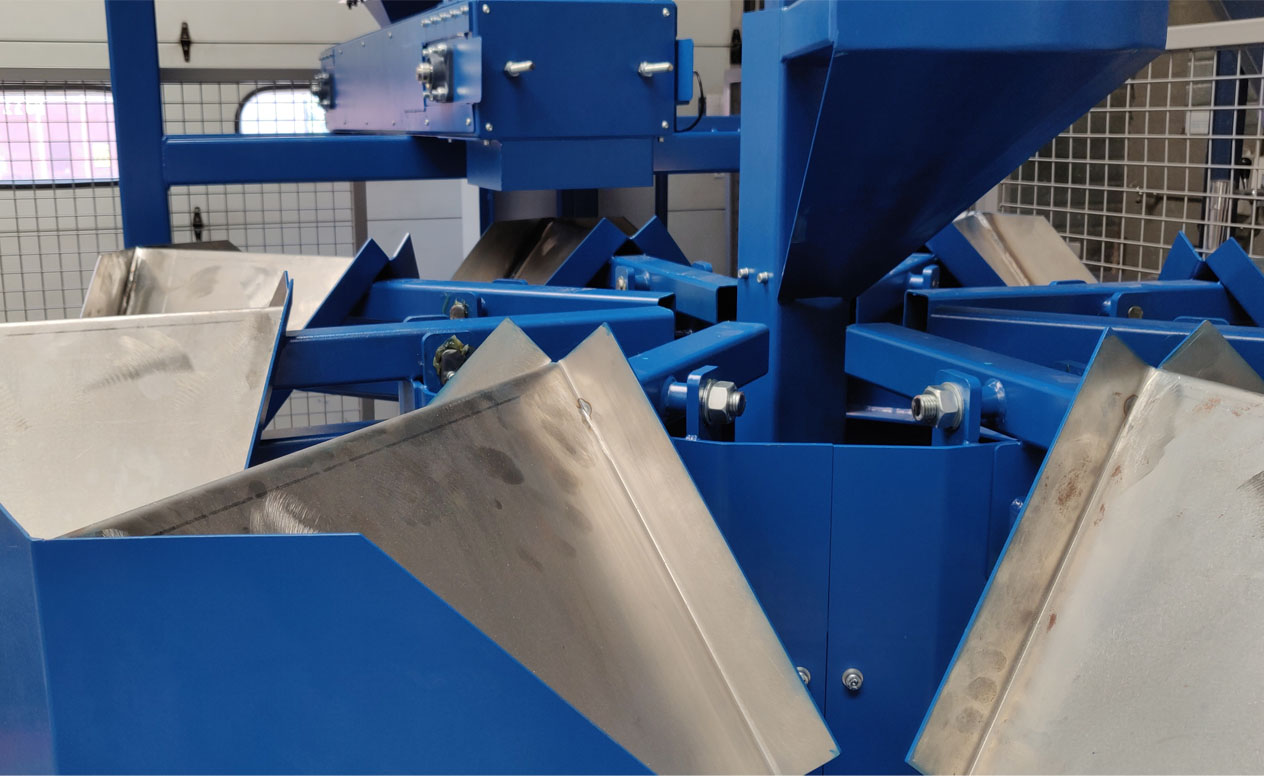
To process the material, a belt feeder transport the material on to a (turning) carousel with dividing head. The dividing heads guide the falling material to each position where it is collected by (for example) a bucket.
When all the material is divided it can be collected by lifting the dividing heads for easy access.
Features and Benefits
- 300L infeed hopper
- Can handle a wide range of materials
- significantly reduces labor time and effort compared to manual methods
- Accurate and representative samples

Technical Specifications
| Applications | Accurately and efficiently split large bulk material samples into smaller, representative portions for analysis in industries such as mining, agriculture, construction, and pharmaceuticals. |
| Working principle | rotary sample dividing from falling stream of material |
| Maximum volume of funnel | 300L |
| Speed setting | 1 to 7,5 rpm |
| Amount of positions | 8 |
| Material transport method | Vibratory feeder or conveyor belt |
| Setting adjustment method | digital control panel |
| Power supply | 380V ± 10% - 50/60Hz |
| Electrical requirements | 3 kW |
| Power connection | 3 phase |
| Dust extraction point | 1 |
| Required air pressure | 6 bar |
| Standard | CE |
| Protection code |
Control box IP66 Harting plugs IP65 / IP66 / IP67 Vibratory motor hopperIP66 Vibratory motor feeder IP66 Motor carousel IP55 |
| Weight | ≈ 4850kg |
| Dimensions (width x length x height) | 4050 x 2450 x 2900 mm |
300 liter rotary sample divider working principle
The 300liter sample divider is a specialized installation used to accurately split large bulk material samples into smaller, representative portions for laboratory analysis.
This type of sample divider is essential in industries such as mining, metallurgy, agriculture, and construction, where the precise analysis of raw materials is critical for quality control, resource evaluation, and process optimization.
By dividing large samples into smaller, uniform subsets, the sample divider ensures that the laboratory analyses are consistent and statistically reliable.
The installation is equipped with a large-capacity hopper that can hold up to 300 liters of material, making it suitable for processing bulk samples in a single operation.
The sample divider typically uses a rotating mechanism with multiple chutes or slots to distribute the sample evenly into a set of collection containers.
This rotary action ensures uniform distribution, reducing sampling bias.
Depending on the model and requirements settings to control the speed of rotation and sample flow rate can be adjusted
Built with durable materials such as stainless steel or abrasion-resistant alloys, the equipment is designed to withstand harsh industrial conditions and heavy, abrasive materials.
The bulk sample is loaded into the hopper, where it flows downward through the rotary dividing mechanism.
As the divider rotates, it evenly distributes the sample into multiple collection bins or containers placed below, each receiving a representative fraction of the original sample.
This process can be repeated to further subdivide the sample into smaller portions if needed for detailed analysis.

300L Rotary Sample Divider FAQ (Frequently Asked Questions)
Applications
- Used to prepare representative samples of ores, concentrates, and tailings for assay and metallurgical testing.
- Ideal for dividing samples of grains, seeds, or fertilizers to ensure quality and safety testing.
- Used to sample aggregates, soils, and other construction materials to verify compliance with standards.
- Employed to split bulk powders and chemicals for analytical testing and quality control.