


RSD4 Table Model
Small model of the rotary sample divider for accurate laboratory sampling results
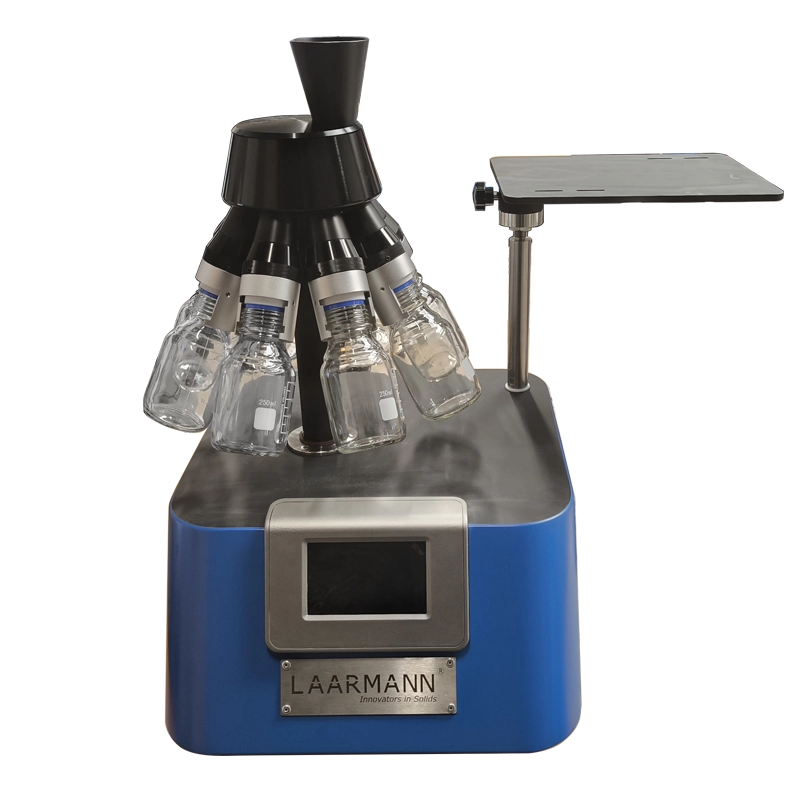
The RSD4 Sample Divider is designed to evenly split a single sample into 6, 8, or 10 uniform sub-samples. Each of these sub-samples maintains identical physical and chemical properties, ensuring that they accurately represent the characteristics of the entire batch. This guarantees highly reliable and reproducible sample division for analytical processes.
Features and Benefits
- Rapidly and evenly divides small quantities of material
- Compact Design for laboratory and desk usage
- Ensures a representative sample
- Easy to operate and maintain
Technical Specifications
| Applications | sampling, sample division, sample reduction |
| Applications fields | Agriculture | Biology | Chemistry / Plastics | Construction Materials | Engineering / Electronics | Environment / Recycling | Geology / Metallurgy | Glass / Ceramics | Medicine / Pharmaceuticals | Mining and Mineral Processing | Cement and Building Materials Industry | Food and Feed Production | Pharmaceuticals | Environmental Labs (e.g. Soil and Waste Analysis) |
| Working principle | The rotary sample divider ensures precise and reproducible sample division by evenly distributing bulk material through a rotating feed system into multiple collecting containers. As the sample flows onto the rotating dividing head, it is split into representative portions according to the selected dividing module and ratio. This process guarantees dust-free, uniform, and reproducible division of powdered or granular materials, providing a representative sample for accurate analysis. |
| Maximum feed size* | ≤10 mm |
| Batch size / feed quantity* | ≤5000 ml |
| Throughput | <500 ml per batch |
| Speed setting | 8 - 120 rpm |
| Number of divisions | 6 - 8 - 10 bottles |
| Collector Volume | 30 ml / 100 ml / 250 ml / 500 ml |
| Hopper volume | n/a to be ordered seperatly (LM-VF100) |
| Sample volume | 30 ml / 100 ml / 250 ml / 500 ml |
| Material transport method | n/a to be ordered seperatly (LM-VF100) |
| Product-contact parts | Aluminum |
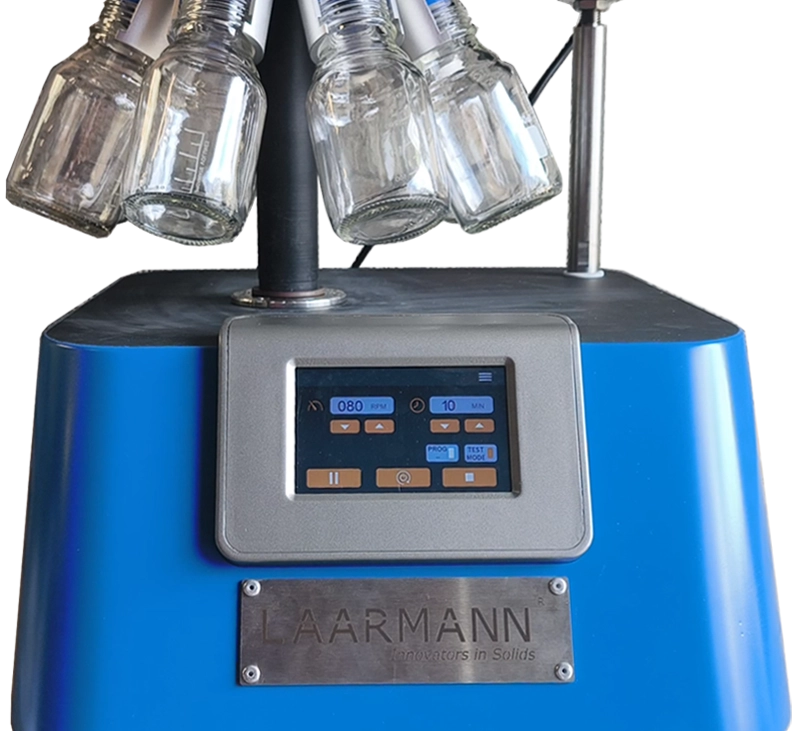
| Setting adjustment method | Digital control panel with preset option |
| Setting options | Rotation speed, time adjustment |
| Time setting | 1min-999min |
| Fuses | 10amp glass fuse |
| Noise emission | ±35 dB(A) |
| Electrical requirements | 110-120V or 220-240V, 50/60 Hz |
| Power supply | <100Watt |
| Current | 1.6A |
| Power connection | 1 phase |
| Standard | CE |
| Protection code | IP54 |
| Weight | 30kg |
| Dimensions (width x length x height) | 460 x 456 x 850 (L x W x H in mm) |
RSD table model working principle
The sample is fed from a hopper (typically via the LMVF100 vibratory feeder) to create a steady, controlled stream.
The material enters the RSD-4?s rotating distribution pipe, which spreads the stream evenly and directs it into multiple outlets while rotating.
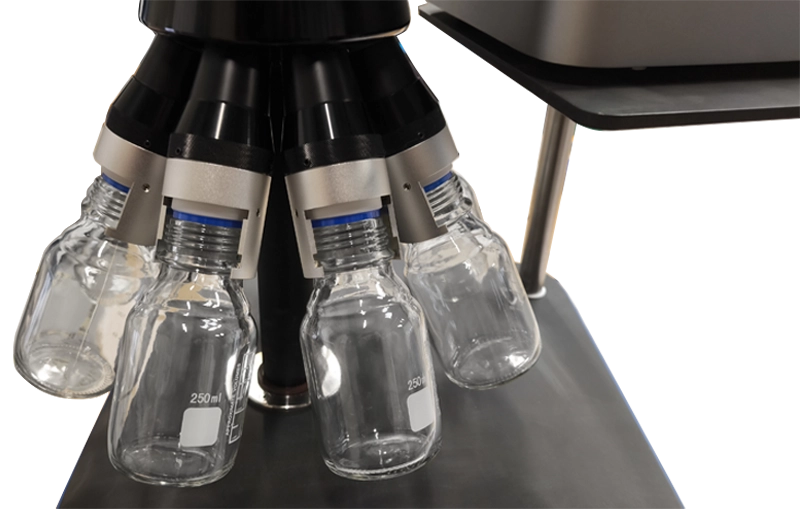
As the bottle carousel passes these outlets, the sample is distributed in equal portions into 6, 8, or 10 collection bottles.
Division quality is controlled by the digital control panel through rotation speed (8?120 rpm) and time settings, helping achieve repeatable splits for powders and granular materials (?10 mm feed).
A dust extraction point supports cleaner operation during routine laboratory sampling.
RSD4 Table Model FAQ (Frequently Asked Questions)
Applications
- Used to prepare fine ore or mineral samples for chemical analysis, ensuring representative sub-samples.
- Ideal for dividing fine powders or granules for quality control testing.
- Used to split fine soil or seed samples for various agricultural studies.
- Suitable for preparing small sub-samples of fine particulate matter for environmental testing.
Visit our Applications page for our database of specific applications